Thinking About Selling? Avoid These 5 Costly Mistakes.
Selling a home in San Francisco is rarely just a financial transaction; it is a significant life transition. Whether you are upsizing for a growing family, downsizing to simplify your life, or relocating for a new chapter, the process is inherently emotional.
However, the San Francisco market operates on a unique set of rules. Success here requires moving beyond "real estate as usual" and embracing a strategic, data-driven approach that prioritizes the buyer’s experience.
To ensure your transition is as smooth and profitable as possible, here are the five most common pitfalls I help my clients avoid.
1: Staging for Yourself Instead of Your Buyer
THE MISTAKE: Treating preparation as a "deep clean" while keeping personal furniture or clutter.
This one is deeply human. You’ve lived in this home. You painted that wall the color you’ve always loved. You know which floorboard creaks and why the light in the kitchen is perfect at 4pm. Those memories are real — and they make it almost impossible to see the space the way a first-time visitor does.
Most sellers clean before listing. They hire a service, vacuum the corners, wipe down the appliances. What they miss is the edit. Studies on buyer psychology consistently show that a home’s first impression forms in roughly seven seconds. That’s the moment someone steps through the door and their eyes sweep the room. If that scan catches the stack of mail on the kitchen counter, the bookshelves loaded with a lifetime of collections, or the family photos that make the hallway feel personal to you — the brain registers clutter before it registers the home. You’ve lost them before you’ve started.

BEFORE: Client wanted to list with their furniture, belongings.

AFTER: Editing and Professional Staging secured a successful sale.
THE FIX: The moment you decide to sell, your job changes. You’re no longer a homeowner — you’re a product marketer. Every decision from that point forward asks one question: What does today’s buyer want to see?
A good stager doesn’t just add things. They subtract. Actively “edit” every room to maximize natural light and draw the eye to the heart of the home — the kitchen, a fireplace, a city view, a dramatic ceiling. Remove anything that competes with those focal points. In a city where square footage is at a premium, the feeling of openness is worth real dollars.
2: The Pricing Pitfall: Avoid "Aspirational" Pricing
THE MISTAKE: Listing high “just to test the waters,” assuming you can always lower the price later if needed.
It feels logical. You’ve seen what your neighbor got for their place. You’ve watched prices climb. Why not aim high and see what sticks? You can always come down.
The most expensive number in real estate is often the one you start with.
The data says otherwise. In SF’s hyper-competitive market, the first week on the market is everything. Buyers are watching new listings in real time. A home that’s priced too high gets fewer showings, fewer offers, and accumulates days on market — which becomes a scarlet letter. When the price reduction comes, buyers wonder what’s wrong with it. You’ve lost your best moment.
THE FIX: Price transparently using block-by-block comparable data. In many San Francisco neighborhoods, the proven strategy is to price at or slightly below market to create competitive tension among buyers. That’s not leaving money on the table — that’s what triggers a bidding war.
In Q1 2026, homes priced correctly were selling in a median of 11 days and closing at 119% of list. The sellers who tried to get clever with aspirational pricing watched those same buyers walk across the street.
3: The Turnkey Premium: Selling Perfection

THE MISTAKE: Assuming buyers will happily take on your deferred maintenance, cosmetic projects, or “it just needs a little TLC” issues — and price accordingly.
Sellers often rationalize deferred maintenance as the buyer’s problem. “We’ll just price it a bit lower.” The logic sounds reasonable until you see how buyers actually behave.
Today’s SF buyer — particularly in the tech-wealth demographic driving this market — is time-poor and risk-averse. They’re not looking for a project. They’re looking for a home they can move into without surprises. When they see a home that needs work, they don’t just discount for the cost of the repair. They discount for the uncertainty, the inconvenience, and the perceived risk of what else might be hiding.
THE FIX: Do the work before you list. Fresh paint, updated hardware, repaired fixtures, landscaping — these investments return multiples in a competitive market. A home that is genuinely turnkey commands a premium that almost always exceeds the cost of the prep.
If the work is substantial and you can’t do it, price honestly to reflect that. But go in clear-eyed: buyers will price the deferred maintenance at double what you would, and your days on market will show it.
4: Failing to Market the Neighborhood
THE MISTAKE: Spending all your marketing energy on the four walls — the finishes, the square footage, the floor plan — while completely ignoring the thing that makes San Francisco real estate unlike anywhere else: the neighborhood itself.
Buyers moving to — or within — San Francisco aren’t just buying a home. They’re buying into a micro-community. The Castro, Noe Valley, the Richmond, Bernal Heights — each one has a distinct character, a walkability profile, a set of local institutions that define daily life. The coffee shop you’ve been going to for ten years. The farmers’ market two blocks away. The dog park, the hidden staircase, the restaurant where everyone knows your name. That context is what transforms a house into a home for the next buyer.
Buyers relocating from other cities — a growing segment as tech companies continue to bring talent in — are making a neighborhood decision as much as a property decision. If your listing doesn’t tell that story, someone else’s will.
THE FIX: San Francisco buyers aren't just buying square footage; they are buying a lifestyle. We build a narrative around the "hidden wonders"—your local shopkeepers, the discrete vantage points atop a hidden staircase, and the community vibe that makes the home feel part of a greater whole. My deep ties to Eureka Valley and the Castro allow me to market your home’s proximity to these invaluable cultural hubs.
Check out some of our Neighborhood Guides



5: Waiting for the “Perfect” Market
THE MISTAKE: Putting your life on hold trying to perfectly time interest rates, market peaks, or “the right season” — and missing the window that’s already open.
The financial headlines are noisy right now. Rates climbed back to 6.46% in early April. There’s geopolitical uncertainty. National housing starts are slowing. It’s easy to read all of that and decide to wait for things to settle.
Sources: SFAR MLS & BrokerMetrics; Property types covered: Single-family, Condominiums, Loft condominiums, TIC, and Stock COOP. Only property data posted on the MLS is covered. All information is deemed reliable, but not guaranteed for accuracy. All data is subject to errors, omissions, revisions, and is not warranted. ©2026 Vanguard Properties. All rights reserved. Equal Housing Opportunity. DRE No. 01486075
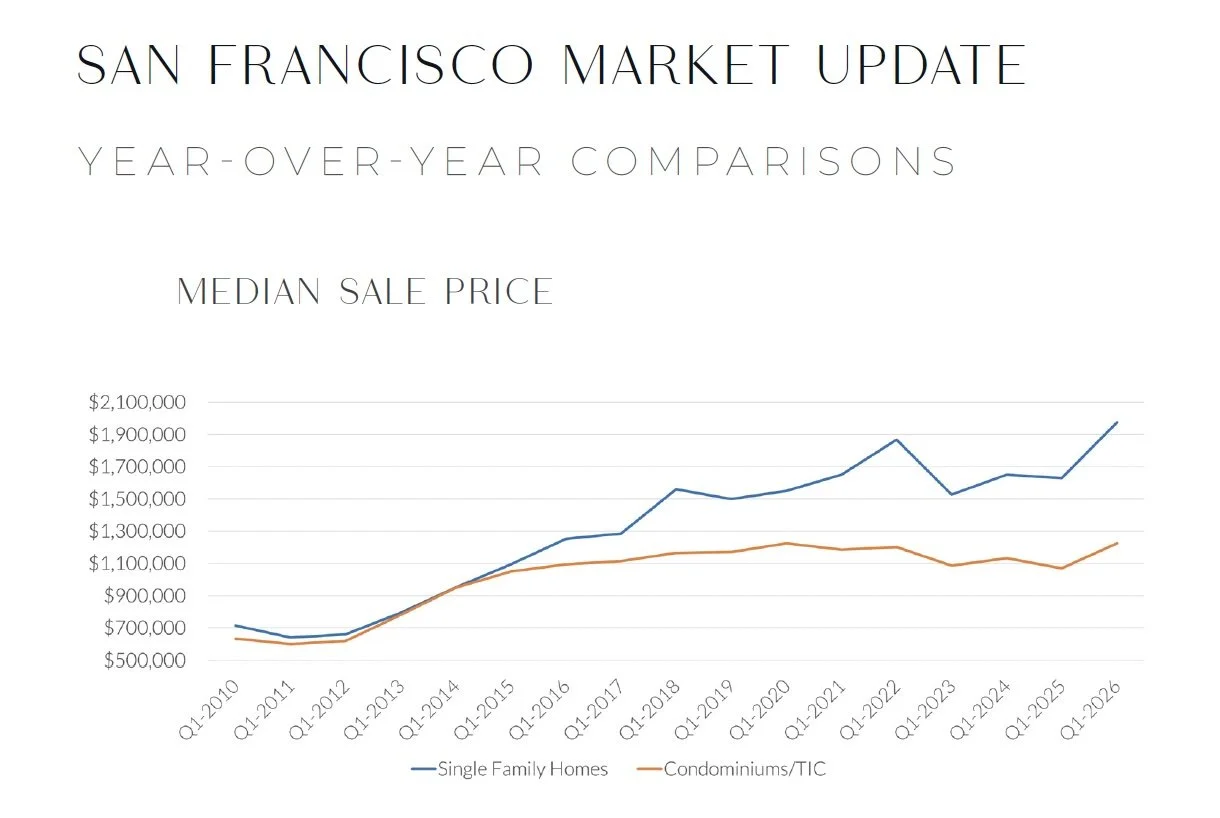
But San Francisco doesn’t move in lockstep with national trends. Our market is driven by structural housing scarcity and concentrated technology wealth — two forces that don’t evaporate because of bond market volatility. With only 179 single-family homes for sale citywide in Q1, inventory has rarely been tighter.
THE FIX: Stop letting market speculation dictate your life transitions. If you need to upsize for a growing family, downsize as an empty-nester, or move closer to where your life actually is — those are the right reasons to sell. Not because the rate chart looks perfect.
The data from 2015 to 2025 tells a clear story: SF homeowners who waited for the “perfect” moment often waited themselves out of the market entirely, while those who moved when their life called for it captured appreciation they never expected. What matters most is your happiness — and the right plan to protect your equity while you pursue it.
The Bottom Line
Selling in San Francisco doesn’t require luck or perfect timing. It requires preparation, honest pricing, and a clear-eyed understanding of what today’s buyers are actually looking for. Get those three things right, and this market will do the rest.
I’ve spent 25 years in this city helping sellers navigate exactly these decisions — from the first conversation about whether now is the right time, to handing over keys at close. My job is to make sure you leave the table with every dollar you’ve earned.
If you’re thinking about selling — this spring, this summer, or even a year from now — the best first step is a conversation. No pressure. Just the numbers and a plan.